

.svg)
.webp)
Proven Technology for Marketing Exhibitions: From Footfall to Pipeline
Struggling to prove exhibition ROI? This guide breaks down technology for marketing exhibitions that improves check-in flow, lead quality, and attribution.
Marketing events in 2026 are no longer judged solely by footfall or brand visibility. If you’re an event director, exhibition owner, or ops lead, you’re being measured on pipeline contribution, lead quality, and post-event attribution. Yet many marketing exhibitions are still powered by disconnected tools. One system for registration, another for badges, another for lead capture, and no reliable way to connect on-site engagement to real revenue outcomes.
This is where the wrong technology for marketing exhibition environments quietly erodes ROI. Attendees arrive at long registration queues. Badges are printed with outdated data or incorrect job titles. You scan leads but can’t properly qualify them, forcing sales teams to chase hundreds of low-intent contacts after the event. Meanwhile, marketing teams struggle to answer basic questions. These include: Which sessions influenced buying behavior? Which booths attracted decision-makers? Which interactions actually mattered?
In this article, we break down the best technology for marketing exhibitions in 2026. You’ll learn how modern technology for marketing exhibition strategies supports faster on-site flow, higher-quality lead capture, real-time performance visibility, and post-event reporting.
Before You Begin
- Disconnected tools break the link between registration, on-site engagement, and pipeline, creating activity without attribution.
- Fast check-in, live badging, lead intelligence, session tracking, and real-time analytics form the backbone of high-performing marketing exhibitions.
- Structured data, on-site qualification, and session-level insights turn booth traffic into sales-ready signals.
- Poor attendee flow design, late vendor involvement, and overreliance on venue tech not built for marketing exhibitions quietly disrupt exhibitor ROI.
- Top performance-oriented exhibitors design technology early, prioritize exhibitor outcomes, and treat exhibitions as a measurable demand channel rather than just a live event.
Core Problems Marketing Exhibitions Fail to Solve Without the Right Technology
Marketing exhibitions are designed to do one thing exceptionally well: connect brands with qualified buyers and generate a measurable pipeline. However, when the underlying technology for marketing exhibition environments isn’t built for that goal, the breakdown is both operational and commercial. The gaps show up across the full exhibition lifecycle: before the show floor opens, while buyer intent is forming on-site, and after stakeholders ask for ROI.
1. Before the Event: Poor Data Readiness for Demand Generation
In marketing-led exhibitions, pre-event data is the foundation for exhibitor ROI. Yet many organizations enter the show with datasets that aren’t usable for lead qualification or sales follow-up.
Common pre-show issues include:
- Registration data that isn’t marketing-ready: Required fields focus on access control rather than demand signals. Company size, buying role, product interest, and purchase timeframe are either optional or absent.
- No data alignment between registration, badge profiles, and CRM fields: Attendee data collected during registration isn’t mapped to badge layouts or downstream systems like Salesforce or HubSpot, creating breaks in the lead lifecycle.
Example: An exhibitor running an 800-attendee marketing exhibition allows open-text company names and job titles during registration. On-site, badges display inconsistent data, making it impossible for them to identify target accounts or senior decision-makers. Post-event, marketing teams spend weeks cleaning data instead of activating leads.
2. During the Event: Lost Buyer Intent on the Show Floor
The live exhibition environment is where intent is expressed through booth visits, session attendance, and conversations. When on-site systems aren’t designed to capture that behavior, buyer signals disappear.
Key on-site failures include:
- Check-in congestion that suppresses early booth engagement: Peak arrival queues delay attendees from reaching the exhibition hall, reducing high-value morning traffic for sponsors and exhibitors.
- Manual or disconnected badge scanning for session access: Without digital session scanning, attendance data is incomplete, limiting insight into content-driven buyer interest.
- High lead volume with no context or qualification: You scan badges rapidly but can’t capture intent, priority, or conversation outcomes in real time.
Example: At a SaaS-focused marketing exhibition, exhibitors may collect hundreds of scanned leads per day. However, without custom qualifiers tied to the buying stage or product interest, their sales teams receive flat lead lists. There's no differentiation between students, researchers, and in-market buyers.
Also Read: 10 Effective Strategies to Reduce Peak Event Registration Congestion
3. After the Event: Marketing Attribution and ROI Blind Spots
Marketing exhibitions are increasingly scrutinized for revenue impact. When post-event reporting can’t link on-site behavior to outcomes, confidence in the channel reduces.
Typical post-show gaps include:
- Unreliable engagement metrics for sessions and exhibitors: Attendance counts are estimated, delayed, or manually reconciled.
- Low sales trust in exhibition-generated leads: Leads lack engagement context, leading to inconsistent prioritization and follow-up.
Example: Two weeks after a global marketing exhibition, the organizer delivers lead files to exhibitors with no insight into which attendees attended product demos, premium sessions, or high-intent meetings. Sales teams may downgrade the leads. As a result, the exhibition’s contribution to the pipeline may be called into question, despite strong on-site engagement.
Key Insight: Across all three phases, the pattern is clear. When technology is selected late, deployed in silos, or focused only on access and logistics, marketing exhibitions generate activity without insight. The result is weaker exhibitor ROI, lower sponsor renewal rates, and limited confidence in exhibitions as a scalable growth channel in 2026.
.avif)
To close the gap between activity and attribution, you need technology purpose-built to capture, connect, and activate buyer intent throughout the entire exhibition lifecycle.
Must-Have Technology Categories for Marketing Exhibitions
If you’re evaluating technology for marketing exhibitions, the goal isn’t “more tools.” It’s fewer breaks in the buyer-intent chain, from first touchpoint at registration to lead qualification on the show floor to sales-ready reporting after the event.
A practical way to vet your stack is to ask: Does this technology help me capture buyer intent faster, more accurately, and in a way sales and revenue teams can actually use?
The categories below are the non-negotiables for modern marketing exhibitions.
1. Quick Check-In & Identity Management
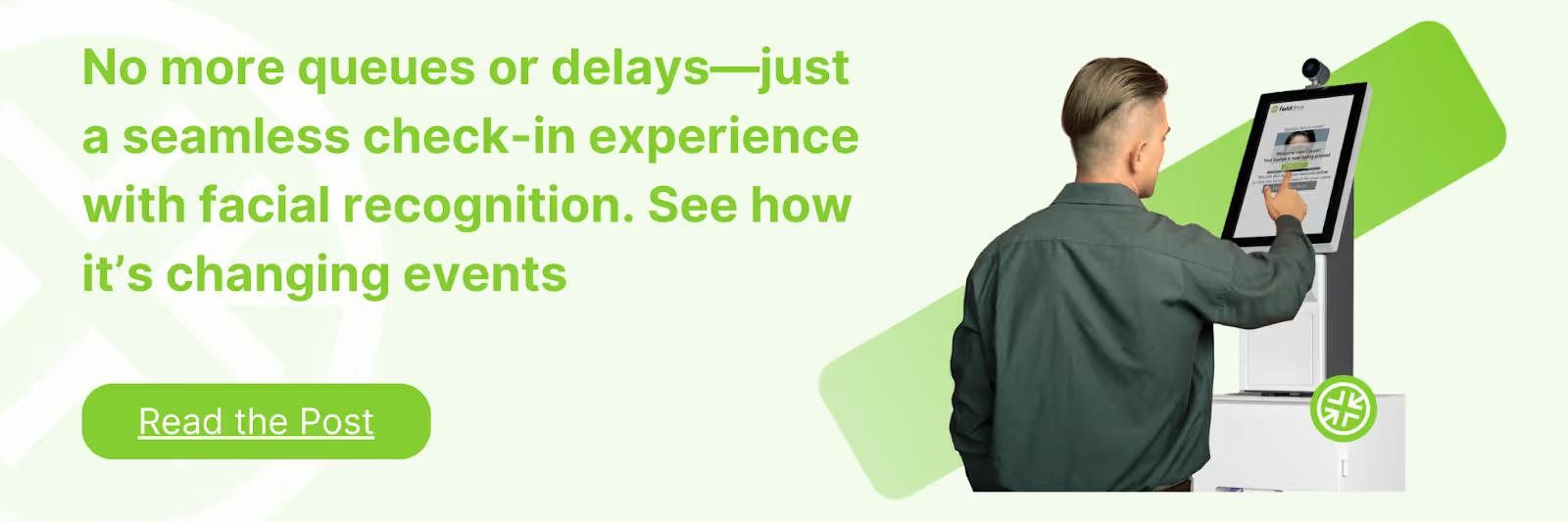
Marketing exhibitions perform or fall flat within the first 15 minutes. If the arrival experience is slow, you lose goodwill, booth traffic, session attendance, and sponsor value during peak hours. That’s why touchless, high-throughput check-in is foundational technology for marketing exhibition success.
Facial Recognition vs. QR vs. Barcode: What To Choose
Think of identity methods as a trade-off between speed and confidence, not a “cool tech” decision.
Key insight: The best technology for marketing exhibition check-in isn’t the one that’s fastest in a demo. It’s the one that stays fast at 8:30–10:00 AM when 60% of daily arrivals hit at once.
Example Workflow (What “Good” Looks Like)
Registration → Identity validation → Live badge print → Entry
- Registration captures structured fields (role, company, interest).
- Identity validation occurs via facial recognition, QR codes, or barcodes.
- Badge prints instantly (and accurately).
- Entry gates or staff validate access if needed.
This is where solutions like fielddrive's touchless check-in kiosks become operationally valuable: you’re checking people in while protecting flow and preserving buyer intent.
Common Pitfalls (and How to Avoid Them)
- Pitfall: Privacy compliance mistakes
Fix: Build a precise consent flow (opt-in language + disclosure), and choose vendors that support privacy-aware implementations. - Pitfall: Poor fallback flows
Fix: Design a “Plan B” that is just as operationally smooth:- Facial recognition fails → QR scan fallback
- QR missing → lookup + quick print
2. Live Badge Printing & On-site Data Accuracy
Pre-printed badges fail marketing exhibitions for one big reason: your attendee data changes right up to showtime. Speakers swap sessions. Job titles update. Walk-in registrations keep coming. Sponsors demand branding adjustments. In such scenarios, pre-printing locks in yesterday’s dataset, and marketing exhibitions run on today’s buyer signals.
That’s why live badge printing is a core technology for the infrastructure of marketing exhibitions.
How Live Badge Printing Improves Outcomes
When badges print in seconds at check-in, you get:
- Higher data accuracy: The badge reflects the latest profile.
- Better sponsor branding: Dynamic templates can clearly reflect sponsor tiers.
- Sustainability: Fewer wasted pre-prints, more controlled print volume.
Pro tip: Use standardized fields in registration (dropdowns where possible) and reserve free text for notes. That alone improves the quality of downstream leads for exhibitors.
Metrics to Track
Metric 1: Badge reprint rate
- Log every reprint and tag the reason (typo, role change, badge damage, wrong template).
- Divide reprints by total printed badges.
Formula: Reprint rate = # reprints ÷ Total badges printed
Metric 2: Check-in throughput
Track the number of attendees processed per minute at peak.
Formula: Throughput = # attendees checked in ÷ Peak window minutes
3. Lead Retrieval & Exhibitor Enablement Tools
If you measure exhibition success by pipeline, then lead retrieval is not a “nice-to-have.” It’s the core commercial system of your show.
In 2026, you need lead intelligence, not just lead volume, making this one of the most crucial technology categories for marketing exhibitions.
What Exhibitors Actually Need
- Clean contact profiles
- Custom qualifiers and scoring
- Immediate access to leads during the show
- Fast export/sync for follow-up
- Notes + context captured at the moment of conversation
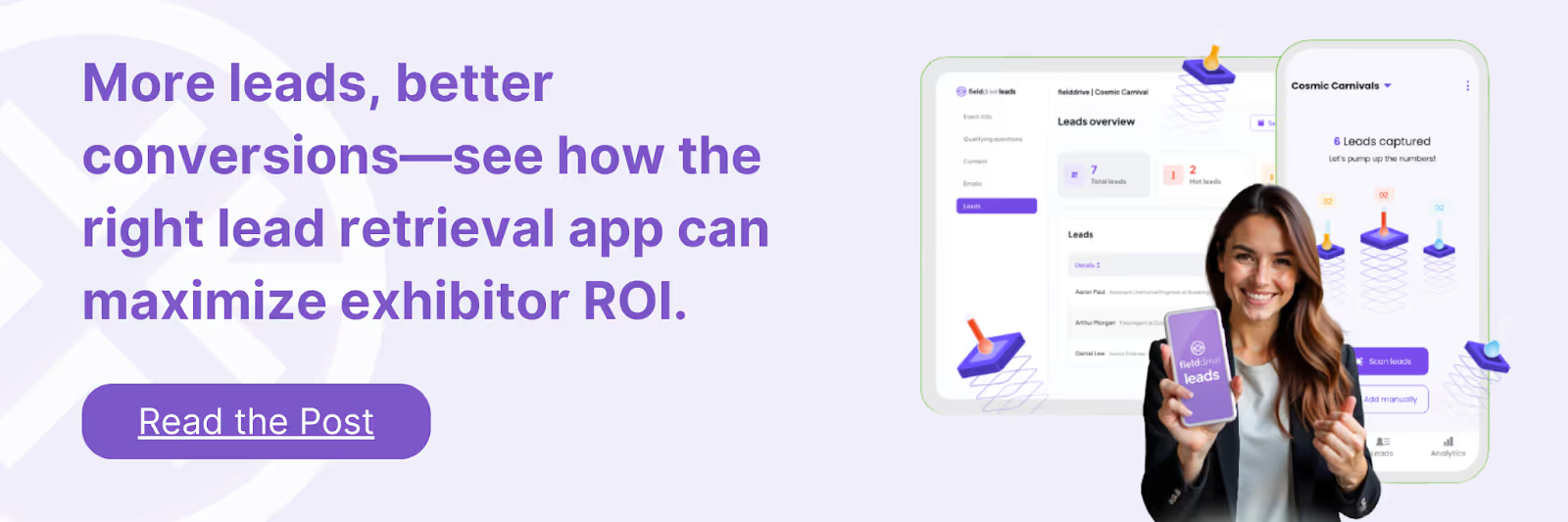
Tools like fielddrive Leads are built around this exhibitor reality: scan badges, capture context, and keep lead data usable in real time.
Scanning ≠ Qualifying (and How to Fix it)
A scan is a capture event. Qualification is a decision. A workable qualification structure includes:
- Buying timeline (0–3 months, 3–6 months, 6–12 months, not evaluating)
- Role relevance (decision-maker, influencer, researcher, student/other)
- Product interest (Product A/B/C, integration needs, pricing request)
Here's a simple lead scoring framework you can actually use. Create a 0–100 lead score based on qualifiers.
Formula: Lead score = Buying Timeline points + Role points + Product Fit points
Metrics You Should Track
- Qualified leads per booth: Define “qualified” (e.g., score ≥ 70) and track daily.
- Time-to-follow-up: How quickly leads are contacted after capture (same day, next day, >7 days).
- Lead-to-meeting conversion on-site: Leads that turn into scheduled demos or follow-up meetings.
Pro tip: Require at least one qualifier + one note (for instance, "wants a demo, comparing two vendors" for every scanned lead. It reduces junk data and increases sales trust.
4. Session Access Control & Attendance Tracking
In marketing exhibitions, session data is often your most underused attribution asset. Session attendance signals intent, especially for product-specific breakouts, technical workshops, and executive panels.
Why Session Data Matters for Marketing Attribution
If you can connect session attendance to leads, you can answer:
- Which sessions influenced product interest?
- Which content themes correlate with high-quality leads?
- Which sponsors drove meaningful engagement?
This requires digital session scanning and attendance tracking, not manual headcounts.
How to Connect Session Attendance to Lead Scoring and Follow-Up
Workflow practical applications:
- Session attendance → lead scoring
Example: “Attended Pricing & Implementation Workshop” adds +15 score. - Content interest → follow-up messaging
- Example: Attended “AI automation demo” → send technical integration guide, not a generic brochure.
Pitfalls to Plan For
- Over-scanning (double scans inflate attendance)
Fix: Configure scanning logic to allow one check-in per session window. - Offline data loss
Fix: Use scanners that store offline and sync later, with clear reconciling rules.
5. Real-Time Analytics & Post-Event Intelligence
Marketing exhibitions should not be “measured later.” In 2026, the best teams use data during the show to protect flow, improve event outcomes, and adapt programming. This is where analytics dashboards become high-leverage technology for marketing exhibition beyond just reporting.
Dashboards That Matter (and What to Do With Them)
- Check-in velocity (arrivals per minute)
- Action: open more kiosks, redeploy staff, activate overflow lanes
- Booth traffic signals
- Action: adjust floor announcements, redirect attendee flows, support sponsor activations
- Session drop-off (entry vs. retention)
- Action: adjust room management, improve wayfinding, and refine session scheduling for the next day
How to Use Data During The Exhibition
A simple “daily ops huddle” rhythm works. For instance:
- 9:30 AM: Review check-in velocity + queue hotspots
- 1:00 PM: Review session attendance vs. expectations
- 4:30 PM: Review exhibitor lead activity + bottlenecks
Post-Event Reports That Sales Teams Trust
To earn trust, reports must answer sales questions clearly:
- Who engaged?
- What did they engage with?
- How strong was the intent?
- What should we do next?
A sales-trustworthy report typically includes:
- Lead lists with qualifiers + notes + scores
- Session attendance tied to topic interest
- Attendee engagement summaries by day
- Clean export or integration into CRM
Real-world Case Study: See how fielddrive improved event check-ins and badging for Burger King UK.
Other Relevant Tech for Marketing Exhibitions
These can be powerful, but they should sit on top of the core on-site stack rather than replace it.
- Hyper-personalization engines: Recommend sessions/booths based on profile and behavior. Best when fed by accurate badge, session, and lead data.
- XR/AR/VR product experiences: Strong for complex product demos, but ROI depends on capturing participation data and tying it back to leads.
- Dynamic content and recommendation systems: Useful for agenda personalization and sponsor exposure again, only as good as the data feeding them.
- Community-building platforms: Great for pre-event engagement and post-event retention, but must connect to on-site identity and lead capture to prove value.
Also Read: 12 Creative Ideas for Impactful Marketing Events
When these core systems are in place, marketing exhibitions can consistently capture intent, protect exhibitor value, and produce defensible ROI. However, even strong technology stacks can fall short when selection and deployment decisions are misaligned. Let's explore that side next.
Common Mistakes Teams Make When Choosing Marketing Exhibition Technology
Even experienced directors run into trouble when selecting technology for marketing exhibition environments. The issues are about misaligned decisions that weaken flow, lead quality, and ROI. Below are the most common mistakes, tied to what actually matters.
1. Ignoring On-site Flow Design
What goes wrong: Technology is chosen without considering how attendees physically move through registration, the exhibition hall, and sessions.
Why it matters: Poor flow reduces early booth traffic and sponsor visibility, especially during peak arrival windows.
Best practice: Map arrival peaks, check-in capacity, and hall entry points first. Then deploy technology that supports fast throughput and distributed access, not centralized bottlenecks.
2. Treating Exhibitor Success as Secondary to Operations
What goes wrong: Technology decisions focus on the convenience of organizers (registration, access control) while overlooking exhibitor outcomes.
Why it matters: Marketing exhibitions exist to generate demand. If you can’t identify high-intent visitors or act on leads quickly, sponsorship renewal rates suffer.
What to do instead: Evaluate technology for marketing exhibition through an exhibitor lens:
- Can leads be qualified on-site?
- Is the data usable immediately?
- Are engagement insights accessible without manual cleanup?
3. Choosing Vendors Too Late
What goes wrong: On-site technology partners are brought in after layouts, registration, and processes are already fixed.
Why it matters: Late involvement limits optimization and forces workarounds instead of intentional experience design.
Best practice: Engage technology vendors early during planning, not just deployment.
4. Assuming Venue Technology Will Fill the Gaps
What goes wrong: Relying on venue Wi-Fi, scanners, or access systems that aren’t designed for high-volume marketing exhibitions.
Why it matters: Venue tech is optimized for access, not data integrity, lead intelligence, or exhibitor reporting.
What to do instead: Choose a technology stack that is:
- Self-contained and portable
- Offline-capable
- Proven in large-scale, multi-day environments
Final Thoughts
Marketing-focused exhibitions nowadays demand more reliable logistics, intentional design, measurable engagement, and technology that supports buyer journeys from entry to follow-up. The right technology for marketing exhibition environments helps you protect attendee flow, capture high-quality intent signals, and give exhibitors the data they need. Teams that think beyond tools and focus on how technology supports outcomes are better positioned to deliver exhibitions.
This is where fielddrive stands apart. As an intelligence-driven on-site event partner, fielddrive goes beyond deployment to advise early, execute precisely, and deliver insight after the show. From facial recognition and touchless check-in to lightning-fast live badge printing, real-time analytics dashboards, and exhibitor lead-retrieval tools, fielddrive enables smooth, data-rich experiences that scale.
If you’re planning your next marketing exhibition, now is the time to step back and evaluate your current tech stack. Speak with fielddrive early in the planning process to design attendee flow, data capture, and exhibitor success before anything is locked in.
FAQs
1. What data fields are most critical to capture at marketing exhibitions?
Beyond basic contact details, critical fields include buying timeframe, role in the decision process, product interest, and engagement type. These fields allow sales and marketing teams to prioritize leads and tailor follow-up effectively after the exhibition.
2. Can marketing exhibitions deliver ROI without mobile event apps?
Yes, many exhibitions generate more substantial ROI through on-site-first technologies such as check-in systems, badging, session scanning, and lead retrieval. Apps can add value, but they are not required to capture buyer intent or exhibitor performance data.
3. What’s the highest hidden cost of poor exhibition technology choices?
The highest hidden cost is exhibitor churn. When you can’t prove ROI or trust lead data, the higher management often decides to reduce booth size, downgrade sponsorships, or not exhibit at all next year. That, in turn, impacts long-term revenue far more than upfront technology spend.
4. How should you evaluate technology scalability for growing exhibitions?
Apart from attendee volume, scalability includes concurrent check-ins, badge-print throughput, lead scans per hour, and data-sync reliability. Stress-testing technology under peak conditions is more revealing than vendor feature demos or case claims.
.svg)
.svg)
.svg)
Want to learn how fielddrive can help you elevate your events?
Book a call with our experts today


.svg)