

.svg)
.webp)
Exploring the Impact of AI in Trade Shows: A Must-Know Guide in 2026
Discover how AI in trade shows enhances check-in speed, booth engagement, and revenue forecasting. Gain actionable tips to run smarter, data-driven events.
Trade show owners often operate in compressed, high-stakes environments. Thousands of attendees arrive within narrow time windows. Exhibitors expect qualified, real-time lead data. Various tracks require controlled access. Sponsors demand measurable ROI. When check-in slows, aisles clog, or lead data lacks depth, the impact is immediate. That includes lost booth traffic, delayed sessions, frustrated exhibitors, and a team forced into reactive mode.
That’s where AI in trade shows moves from buzzword to business imperative. According to recent industry research, roughly 70% of event planners are incorporating AI to optimize processes such as registration and attendee engagement. For trade shows specifically, this shift reflects a move toward smarter queue management, better crowd flow forecasting, and higher-quality exhibitor lead capture.
In this article, we’ll break down how AI is being implemented at trade shows in real-world settings. That includes areas like intelligent check-in, dynamic floor monitoring, AI-enhanced lead qualification, and post-show performance analysis.
Quick Snapshot
- AI helps you analyze historical arrivals, registration velocity, and session trends to predict surges, allocate check-in capacity, and prevent registration bottlenecks before they impact the floor.
- Through heatmaps, dwell-time data, and behavioral signals, it lets you optimize booth placement, balance traffic density, and deliver personalized session and exhibitor recommendations.
- It enables you to score leads based on engagement depth, session alignment, and qualifier responses, so you can prioritize high-intent prospects and accelerate follow-up.
- AI helps you monitor demand signals, ticket velocity, and channel performance in real time to adjust pricing, reallocate budget, and attract higher-value attendee segments.
- In the near future, AI will integrate predictive analytics, wearables, translation tools, and IoT data to create adaptive, globally accessible, and more performance-driven trade show experiences.
The Evolution of Trade Shows: From Booth Space to Intelligent, Data-Driven Experiences
Trade shows have always been built on one core objective: bringing buyers and sellers together in a physical space where relationships and revenue can grow. The fundamentals haven’t changed over the years: exhibitors still need visibility, organizers still need strong attendance, and sponsors still expect measurable returns.
What has changed is the operational complexity behind delivering those outcomes. Today’s trade shows involve:
- Thousands of attendees arriving in compressed time windows
- Multi-track shows running alongside expo floors
- Sponsors expecting real-time performance data
- Exhibitors demanding qualified, enriched leads, not just badge scans
- Leadership teams asking for post-event ROI breakdowns
For you, this shift means the traditional “booths and badges” model is no longer sufficient. The pressure is no longer just about filling floor space. Now it involves engineering flow, improving data visibility, and achieving measurable engagement at scale.
This is where AI is transforming execution across the lifecycle. It is no longer confined to chatbots or marketing automation. It is embedded in how attendees move, how exhibitors sell, and how you measure success. Here’s how it’s reshaping the modern trade show lifecycle.
How AI in Trade Shows Drives Planning Precision, Exhibitor Performance, and Revenue Intelligence
For trade show directors, exhibition heads, and operations leads, AI becomes meaningful only when it improves measurable outcomes. That includes shorter queues, stronger booth traffic, higher lead quality, smarter pricing, and defensible ROI reporting. Below is a detailed breakdown of how AI applies across planning, on-site experience, exhibitor enablement, and post-event revenue acceleration with practical implementation guidance.
1. Predictive Analytics for Capacity, Flow, and Risk Planning
Predictive analytics in trade shows is more than theoretical modeling. It is structured forecasting built on historical attendee behavior, registration velocity, session attendance patterns, and engagement signals from prior editions.
What You Should Be Analyzing
Before applying AI forecasting, ensure your data foundation includes:
- Timestamped check-in records (by 15–30 min intervals)
- Historical registration curve (daily sign-ups by ticket type)
- Session attendance counts by time slot
- Booth traffic heatmaps (if available)
- Marketing channel attribution data
- No-show percentages by segment
Step-by-Step: Forecasting Arrival Surges
Step 1: Calculate Historical Compression Rate.
Compression Rate = (Attendees arriving during peak 30-minute window ÷ Total daily arrivals) × 100
If the previous year’s peak window was 21%, that becomes your surge baseline.
Step 2: Apply to Current Projections.
Projected Peak Volume = Expected Attendance × Historical Compression Rate
Example: 9,000 attendees × 21% = 1,890 arrivals in 30 minutes.
Step 3: Align Infrastructure.
If one kiosk processes 2 check-ins per minute → 120 per hour → 60 per 30 min.
Required kiosks = 1,890 ÷ 60 = 31.5 → 32 kiosks minimum to avoid queuing.
Why This Matters: Without predictive modeling, you may end up underestimating arrival clustering. A 12-minute delay at entry can cascade into:
- Late keynote starts
- Reduced exhibitor dwell time
- Increased congestion in aisle A/B zones
2. Intelligent Floor Design and Booth Allocation
Booth placement decisions are often influenced by commercial hierarchy or legacy positioning. AI introduces data-backed allocation.
Data Inputs for Smart Allocation
- Historical foot traffic density by zone
- Dwell time per aisle
- Category adjacency patterns
- Session spillover flow paths
- Entrance/exit proximity
Practical Framework
Example: Say data shows that AI software buyers attend a 10:00 AM keynote in Hall B. In that case, booth placement for relevant exhibitors near the Hall B exit increases qualified engagement by aligning with intent momentum.
3. Personalized Attendee Journey Design
Modern attendees expect curated agendas. Generic event platforms underperform because they rely on static filters. AI in trade shows enables behavior-based personalization using registration interests, past event behavior, session attendance, and booth interaction data.
Implementation Workflow
- Collect structured registration fields (industry, role, budget authority).
- Track on-site session scans.
- Map exhibitor categories to attendee profiles.
- Deploy the recommendation engine in the event management app/platform.
Performance Metric
Engagement Lift = (Personalized Session Attendance – Baseline Attendance) ÷ Baseline
If baseline session attendance is 45% and personalized prompts increase to 58%, that is a 28.8% improvement.
4. AI-Enhanced Booth Engagement & Lead Scoring
Exhibitors no longer measure success by volume of scans. They measure pipeline contribution. Here's how AI elevates booth performance:
- Capture structured responses (budget, purchase timeline, use case)
- Assign real-time intent score
- Recommend tailored product sheets
Lead Scoring Structure Sample:
Lead Score = (Engagement Duration × 0.4) + (Session Alignment × 0.3) + (Qualifier Responses × 0.3)
This removes guesswork from sales prioritization.
Example: A cybersecurity exhibitor uses AI scoring to flag CISOs who attended a breach management session and interacted at the booth for 6+ minutes. Sales follow-up prioritizes these leads within 24 hours.
5. AI Chatbots and On-site Assistance
Large trade shows create informational friction. Attendees often struggle to locate booths, are confused about session timing, and face language barriers.
AI-powered chatbots and assistants can:
- Provide real-time directions
- Send session reminders
- Translate spoken content instantly to bridge linguistic gaps
- Answer FAQs 24/7
- Answer product-specific questions instantly
6. Dynamic Pricing and Revenue Optimization
Trade shows frequently underutilize demand elasticity. With AI in trade shows, you can monitor:
- Ticket sales velocity
- Abandonment rates
- Competitor event announcements
- Social engagement spikes
That enables you to adjust pricing as per live demand.
Pricing Adjustment Model
New Price = Base Price × (Current Demand ÷ Forecasted Demand)
If demand is 1.15x forecast → controlled upward price adjustment.
Example: A SaaS trade show may adjust pricing after a major speaker announcement, increasing average ticket revenue by 10% without harming attendance volume.
7. Precision Marketing & Channel Allocation
Trade show marketing can no longer rely on broad segmentation or uniform messaging. One-size-fits-all campaigns inflate acquisition costs and attract registrations with low intent. AI enables a shift toward precision targeting. Instead of sending the same early-bird email to an entire database, machine learning models analyze:
- Demographic attributes (industry, job seniority, company size)
- Past ticket purchase behavior
- Session preferences from previous editions
- Engagement with past campaigns
- Online browsing patterns and content interactions
This allows you to tailor promotions by persona and intent level.
For example:
- A VP-level fintech attendee who previously attended paid workshops may receive premium-track bundle offers.
- A startup founder who browses exhibitor listings may receive curated exhibitor previews or discount codes.
Also Read: AI in Event Marketing 2026: Your Guide to Bring High-Quality Attendees
How AI Optimizes Channel Spend in Real Time
AI systems continuously evaluate which acquisition channels are generating not just registrations, but qualified attendees likely to engage, visit booths, and convert into revenue opportunities.
Channel ROI Formula:
Channel ROI = (Net Revenue from Channel – Channel Spend) ÷ Channel Spend
Where net revenue includes:
- Ticket revenue
- Sponsorship uplift tied to attendance growth
- Projected exhibitor pipeline value (if measurable)
Example: Say AI detects that paid LinkedIn campaigns targeting enterprise buyers generate 2x higher lead-to-meeting rates than generic search ads. The budget can be reallocated mid-campaign toward higher-performing segments.
8. Facial Recognition for Frictionless Entry
Registration is the first operational stress test of any trade show. When 1,000+ attendees arrive within a 30-minute window, manual badge lookups and QR scanning can quickly create bottlenecks.
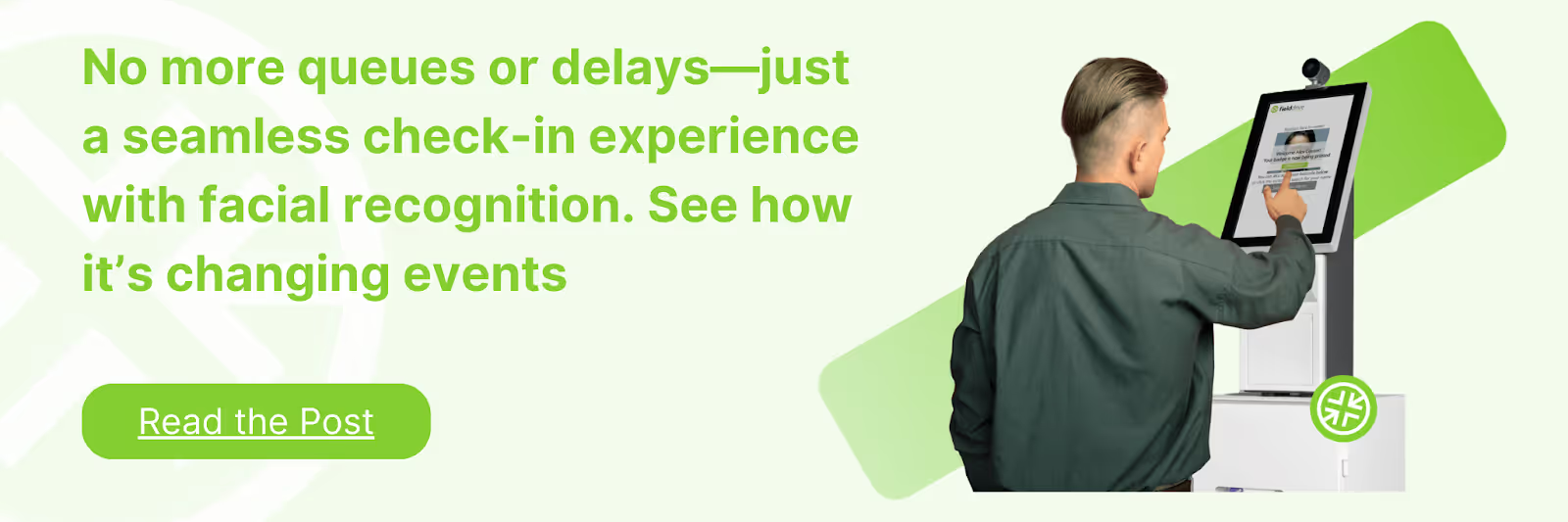
Facial recognition backed by AI simplifies this process. Pre-registered attendees opt in during registration, and upon arrival, camera-enabled kiosks securely identify them in seconds. Their badge prints automatically, or access is granted instantly, eliminating manual verification steps.
Operational Impact
- Faster throughput during peak arrival windows
- Shorter queues and reduced entrance congestion
- Lower staffing requirements at registration desks
- More accurate attendance tracking for sessions and paid zones
Compliance Considerations
Because biometric data is sensitive, deployment must include:
- Explicit opt-in consent
- Encrypted data storage
- Clear opt-out alternatives (QR/manual check-in)
- Defined data retention policies
Also Read: How AI Enhances Facial Recognition: The Essentials Explained
9. Immersive Engagement: AI + VR/AR
On crowded floors, attention is scarce. Static displays and brochures struggle to compete with noise and visual overload. This is where AI enhances immersive technologies like Virtual Reality (VR) and Augmented Reality (AR), transforming booths into experiential environments rather than static spaces.
How AI + VR Works on the Trade Show Floor
Virtual Reality (VR) enables attendees to step into fully simulated environments. Instead of explaining a product verbally, you can:
- Demonstrate 3D product simulations
- Showcase large-scale equipment without physical transport
- Deliver immersive walkthroughs of software platforms
- Simulate real-world use cases in controlled environments
How AI + AR Enhances Physical Booths
Augmented Reality (AR) overlays digital information onto the real-world booth environment using tablets, smartphones, and other devices.
Use cases include:
- Displaying live product specs when a device is scanned
- Showing animated data visualizations over physical models
- Providing interactive navigation to related booths
- Layering performance comparisons in real time
Why It Matters: Immersive experiences increase:
- Booth dwell time
- Information retention
- Lead qualification quality
- Social amplification (attendees share unique experiences)
Example: At an industrial manufacturing trade show, a robotics exhibitor uses AI-powered VR to simulate a fully automated production line. Instead of transporting heavy machinery, attendees explore a digital twin environment. AI tracks which features visitors interact with most and flags high-interest prospects for immediate follow-up.
10. Post-Event Behavioral Intelligence
After the event, AI consolidates:
- Session attendance patterns
- Booth visit sequences
- Engagement intensity
- Lead conversion lag
Post-Event Metrics Table
11. AI-Driven Lead Follow-Up Automation
The follow-up speed influences conversion. AI-enabled CRM systems can:
- Auto-segment leads
- Send tailored follow-ups
- Trigger content recommendations
- Track engagement velocity
Key insight: Leads contacted within 24 hours convert at a significantly higher rate than those contacted after 72 hours.
When these capabilities are connected, AI in trade shows shifts from a collection of tools to an integrated operating system for your event. That integration sets the stage for what comes next.
The Future of AI in Trade Shows: Unified, Predictive, and Borderless
The next phase of AI in trade shows won’t be about isolated tools. Instead, it will be about a connected, intelligent layer running across registration, floor movement, networking, translation, and engagement, all in real time. Here’s what that evolution looks like.
1. Unified, Personalized Event Journeys
Future trade shows will feel adaptive rather than static. AI will likely integrate with:
- Smart badges and wearable devices
- AR glasses and mobile apps
- Venue sensors and interactive kiosks
Attendees could receive:
- Live navigation prompts based on congestion
- Session reminders tied to interests
- Booth recommendations triggered by location
- Intelligent networking matches
2. Global Accessibility Through Real-Time Translation
As international attendance grows, advancements in AI will support:
- Live multilingual session translation
- Real-time subtitling in apps
- Cross-language networking tools
- Automated exhibitor content translation
3. Predictive, Not Reactive, Operations
Future AI systems will anticipate behavior rather than report on it. Expected capabilities include:
- Predicting session overflow before doors open
- Forecasting congestion 10–15 minutes ahead
- Suggesting networking meetings automatically
- Triggering digital flow adjustments
4. AI + IoT + 5G Integration
The convergence of AI with IoT sensors and high-speed 5G connectivity will unlock:
- Real-time density tracking across halls
- Smart lighting and digital signage adjustments
- Dynamic space reconfiguration alerts
- Seamless AR/VR streaming without latency
Also Read: 21 Smart Trade Show Booth Ideas for Small Budgets That Work in 2026
Wrapping Up
Trade shows are no longer measured solely by attendance numbers or booth square footage. As expectations rise from exhibitors, sponsors, and leadership teams, performance is judged by flow efficiency, lead quality, revenue optimization, and measurable ROI. AI in trade shows enables that shift, turning registration data, engagement signals, pricing trends, and behavioral insights into structured decision-making.
This is where fielddrive plays a critical role. As an intelligence-driven on-site event partner, fielddrive embeds AI directly into trade show operational infrastructure. That includes touchless check-in kiosks and live badge printing, as well as session access control, lead retrieval, and real-time analytics dashboards. Through its On-site Tech Advisory Program, fielddrive works with you early to design smarter attendee flow, reduce bottlenecks, and align on-site data capture with exhibitor ROI goals.
If you’re accountable for trade show outcomes and want to move from reactive execution to predictive, data-driven control, reach out to fielddrive. See how its on-site ecosystem can help you simplify operations, enhance exhibitor value, and unlock the full potential of AI in trade shows.
FAQs
1. How does AI help with international attendee engagement beyond translation?
AI can adapt content, recommendations, and engagement workflows based on cultural and behavioral signals. For example, it can tailor session suggestions, networking matches, or exhibitor highlights differently for NA vs. EMEA visitors based on past interaction patterns.
2. What’s the difference between AI automation and AI intelligence in trade shows?
AI automation handles repetitive tasks (such as automated scheduling or content delivery), while AI intelligence interprets data patterns to inform strategic decisions. That includes crowd predictions, personalized journeys, and predictive lead scoring. The latter is where measurable operational improvement occurs.
3. Is AI suitable for small trade shows with limited budgets?
Yes, many entry-level AI solutions scale down to smaller events, using lightweight predictive models for check-in, personalized recommendations, and basic lead scoring. Starting with modular features lets small teams adopt AI gradually without the enterprise-level cost and complexity.
4. How does AI match attendees with relevant exhibitors?
Advanced AI systems analyze attendee profiles, browsing behavior, session attendance, and interaction history to recommend exhibitor matches. This “matchmaking” goes beyond static lists and changes as attendees engage, increasing the probability of meaningful connections.
5. What data sources should you prioritize feeding AI models?
High-value sources include registration metadata, session scans, badge interaction logs, networking app actions, marketing click-throughs, and on-site behavior signals. Quality and consistency in these datasets improve AI accuracy and predictive reliability.
.svg)
.svg)
.svg)
Want to learn how fielddrive can help you elevate your events?
Book a call with our experts today


.svg)