

.svg)
.webp)
How Smart Event Badges Improve Check‑In Speed and Attendee Engagement
Learn how smart event badges speed up check-ins, capture real-time attendee data, improve lead retrieval, and enhance event ROI with modern badge technology.
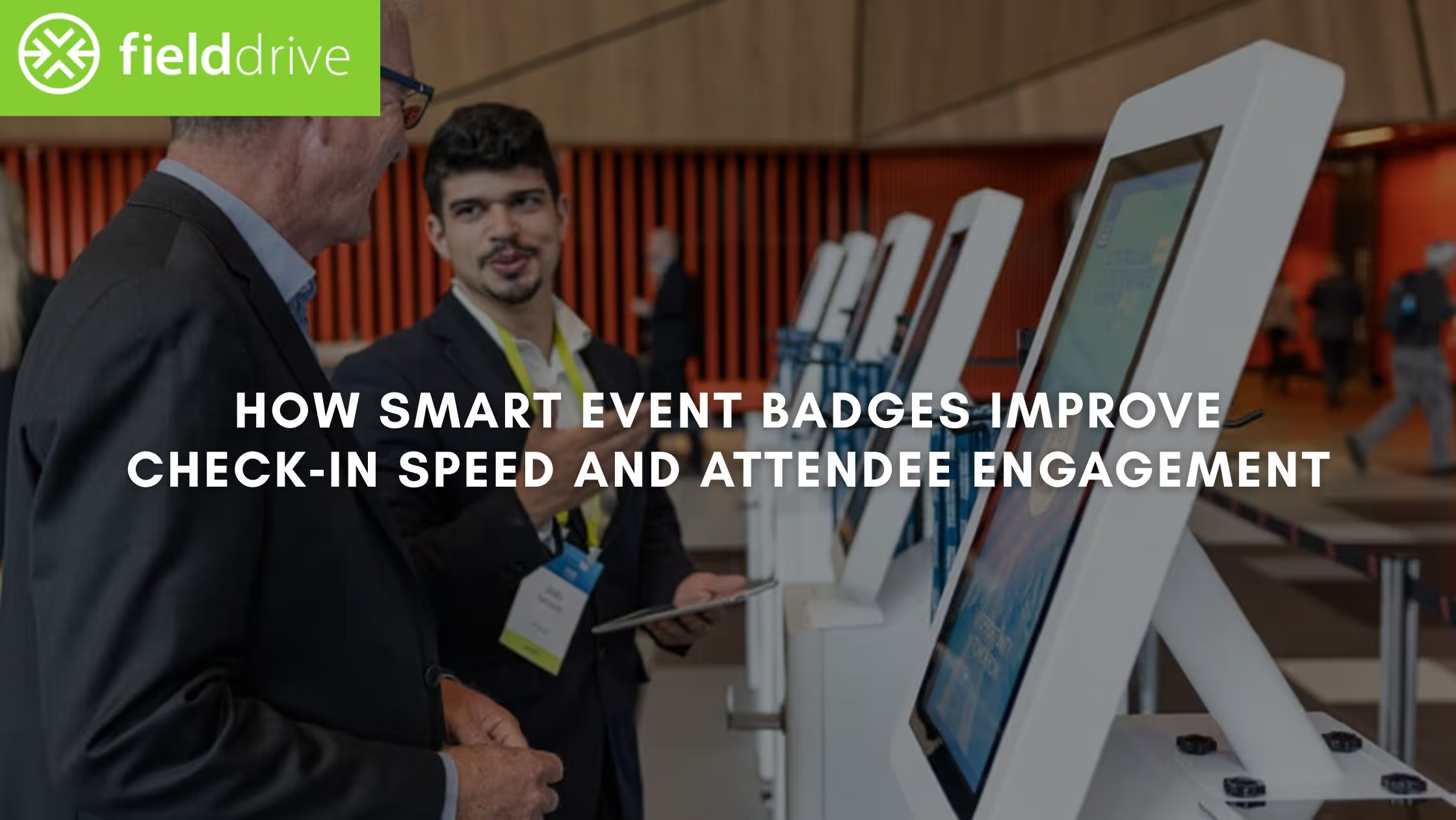
In this blog, we’ll explore how smart event badges can help you tackle these challenges. From speeding up check-ins to capturing valuable attendee data and providing real-time insights, we’ll cover the technologies behind smart badges, their key benefits, and how to implement them for maximum impact at your next event.
Key Takeaways
- Speed Up Event Check-In: Smart event badges reduce long queues and improve check-in efficiency with touchless systems, RFID, and facial recognition technologies.
- Capture Valuable Data in Real-Time: Track attendee movement, session popularity, and engagement with real-time analytics to make on-the-spot event adjustments.
- Improve Lead Capture and ROI: Exhibitors and sponsors can instantly capture leads with smart badges, reducing manual data entry and increasing event ROI.
- Reduce Operational Costs: Automating check-in, badge printing, and access control reduces staffing needs and material costs, saving organisers money.
- Enhance Attendee Experience: Smart badges provide faster, contactless entry and personalized experiences, leading to higher attendee satisfaction and future engagement.
What Is a Smart Event Badge?
A smart event badge looks like a regular name badge or lanyard pass, but it carries embedded technology, such as RFID, NFC, QR codes, or Bluetooth, that allows it to interact with event systems.
In practical terms, when an attendee arrives at an event, their badge can be scanned or tapped, immediately verifying their registration, printing or activating their badge, and tracking their movement across the venue.
Traditional badges simply display static information, while the smart badge transforms that pass into a dynamic piece of the event tech ecosystem.
Benefits of Using Smart Event Badges: Why It Matters for Event Organizers
Smart event badges solve critical challenges for event organizers, offering both practical and strategic advantages. Here's why it matters:
- Faster and More Efficient Check-In
Smart badges automate check-in, reducing long lines and speeding up entry. This minimizes delays and helps organizers manage crowds, ensuring a smooth start to the event.
- Real-Time Data and Insights
Smart badges track attendee movement and session participation in real-time. Organizers get immediate access to data on session popularity, crowd density, and attendee engagement, allowing them to make on-the-spot adjustments for a better event experience.
- Improved Lead Capture for Exhibitors and Sponsors
Exhibitors and sponsors can collect attendee data quickly when individuals tap their badges at booths or sessions. This streamlined process reduces manual entry and improves lead quality, offering better ROI for sponsors.
- Reduced Operational Costs
Smart badges automate processes like check-in and badge printing, cutting down on staff requirements and material costs. Fewer errors at entry points and smoother operations lead to significant savings.
- Better Access Control and Security
Smart badges help manage access to restricted areas, such as VIP zones or session rooms. By integrating with access control systems, organizers can grant or restrict entry based on attendee credentials, improving security and preventing unauthorized access.
- Better Attendee Experience
Reducing check-in time and avoiding long waits creates a positive first impression for attendees. With smoother entry processes, attendees are more likely to have a better experience, leading to improved satisfaction and increased likelihood of attending future events.
- Data-Driven Event Planning
The badge scan analytics data gathered lets organizers understand attendee behavior, optimize future event strategies, and fine-tune marketing efforts. This insight helps build more targeted and engaging events for the present and future.
For attendees, smart event badges used during conferences or exhibitions provide faster, contactless entry with reduced wait times, a personalized experience, easy networking, and access to event content.
Understanding these benefits raises an important question: what makes smart badges actually work? Behind every quick scan and real-time data point sits a specific technology doing the heavy lifting.
Key Technology and Sensors Used in Smart Event Badges
Smart event badges rely on a combination of cutting-edge technologies and sensors to enable seamless attendee management, data capture, and enhanced event security. Here’s a more in-depth look at the key technologies that power these badges:
- RFID (Radio Frequency Identification)
RFID is one of the most widely used technologies in smart event badges. It uses electromagnetic fields to automatically identify and track tags attached to badges without physical contact. RFID tags come in two types: passive and active.
- How It Works: A passive RFID tag used in even check-ins contains a microchip and an antenna. When the badge is scanned near an RFID reader, the chip transmits stored data to the reader, verifying identity or access credentials.
- Why It Matters:
- Speeds up check-in by automating the process.
- Enables contactless interactions, reducing wait times.
- Provides real-time tracking of attendee movement.
- Simplifies lead retrieval for exhibitors.
- NFC (Near Field Communication)
NFC, a subset of RFID, is designed for short-range communication and is effective in environments where proximity is key. It allows two devices, the badge and a reader, to communicate when they are within a few centimeters of each other.
- How It Works: NFC works by using radio waves to exchange data between an NFC-enabled badge and a compatible reader. The use of NFC badges and wristbands for events helps in easy and quick communication with no need for physical contact, making it ideal for smooth check-ins and quick exchanges of information.
- Why It Matters:
- Provides secure, fast, and easy check-ins.
- Ideal for VIP access and specific functionality.
- The system supports badge-to-badge networking for quick data exchange.
- Bluetooth Low Energy (BLE)
BLE is another popular technology for attendee tracking and real-time engagement in large-scale events. Unlike traditional Bluetooth, BLE uses less power, allowing the badge to communicate with nearby Bluetooth devices without draining its battery.
- How It Works: BLE-enabled smart badges emit signals to nearby Bluetooth-enabled devices (like kiosks, session trackers, or smartphones). These devices can track the attendees’ location, monitor interactions, and even push notifications based on proximity.
- Why It Matters:
- Allows proximity-based notifications for real-time engagement.
- Tracks attendee movement and session attendance.
- Uses low energy, extending badge battery life.
- Improves crowd flow management and session tracking.
- QR Codes
Although QR codes for event organizers may seem basic compared to other technologies, they are still highly effective in certain types of events due to their simplicity and low cost.
- How It Works: Each badge has a unique QR code, which can be scanned by an app or scanner. The scanned data is sent to the event system, confirming attendee identity and granting access to various event areas or sessions.
- Why It Matters:
- Cost-effective and easy to implement.
- Event organisers are constantly looking for ways to boost attendance and streamline event operations. Long check-in lines, inefficient registration processes, and the risk of lost leads are common pain points that can detract from the event experience. A study found that event technology adoption can increase attendance by about 20% and cut costs by as much as 30%, making technology-driven check-in solutions more crucial than ever.
- Ideal for smaller events with a simpler setup.
- Quick data collection and attendance tracking for exhibitors.
- Biometric Sensors (Facial Recognition)
The role of biometrics and Facial recognition technology is integrated into smart event badges, providing a highly secure and contactless check-in option for attendees.
- How It Works: Facial recognition systems capture and analyze an attendee’s facial features through cameras at entry points. Once the attendee’s face is scanned, the system matches it with the pre-registered data, granting access if the information matches.
- Why It Matters:
- Provides a completely contactless check-in experience.
- Improves event security by verifying identities.
- Reduces errors and eliminates the need for physical badges.
- GPS and Location-Based Tracking
Some smart event badges are also equipped with GPS or location-based sensors that help track attendee movements in real-time.
- How It Works: Using geofencing technology, organizers can create virtual boundaries within the venue. When an attendee enters or exits a specific area, the badge communicates with the system to log their location. GPS-based tracking allows for precise movement data, which can be used for heat mapping or understanding which areas of the event attract the most traffic.
- Why It Matters:
- Provides insights into attendee behavior and engagement.
- Helps manage crowd density and optimize event space.
- Enables emergency response by tracking attendee locations.
Selecting the right technology mix matters, but execution determines whether your smart badge system delivers on its promise. Moving from concept to deployment requires careful planning across multiple dimensions.
How to Successfully Implement Smart Event Badges at Your Event: A Step‑by‑Step Guide
Each of these steps helps you move from planning to deployment, data capture, and analysis, so your smart event badge solution stays aligned with your event goals.
- Step 1. Define goals and scope: Determine what you want smart event badges to achieve, faster check‑in, better lead capture, tighter access control, or deeper attendee tracking. Match those goals with the event type (corporate meeting, trade show, sports event) and expected attendance size.
- Step 2. Select badge technology and format: Choose the technology that fits your goals: RFID, NFC, BLE, or facial recognition. Decide badge format (badge, wristband, card) based on event environment and attendee profile.
- Step 3. Integrate with registration and event systems: Connect your badge system to your registration platform, CRM, and analytics tools. Make sure that the attendee records (like name, number, ID), access levels, and session attendance and data sync in real time.
- Step 4. Plan hardware and on‑site logistics: Deploy badge readers, kiosks/heavy‑print stations, network connectivity, and power backups. Map placement for registration desks, session rooms, exhibitor zones, and restricted areas.
- Step 5. Design badge contents and user experience: Layout attendee name, company, role, badge type visibly. Embed the chosen technology (chip, QR code, sensor) and test readability, scannability, and comfort for wear duration.
- Step 6. Test systems and train staff: Run end‑to‑end testing: badge printing/activation, reader scans, data flows, access control zones. Train staff in common troubleshooting and attendee assistance.
- Step 7. Execute on site and monitor in real‑time: On event day, deploy the badge system live. Monitor dashboards for check‑in speed, badge scans, session flow, and crowd density. Adjust staffing or routes if issues appear.
- Step 8. Capture data and analyze post‑event: After the event, pull data on badge scans, session attendance, exhibitor interactions, and movement patterns. This is a goldmine of insight; use it to evaluate achievement and plan improvements for the next event.
Following these implementation steps gives you a solid foundation, but the right platform partner can accelerate your results. fielddrive removes much of the complexity by bundling the core technologies, hardware, and integrations into a unified system.
Implement Smart Event Badges at Your Next Event with Fielddrive
fielddrive offers a fully integrated smart badge ecosystem that turns attendee badges into data‑driven assets. Instead of treating badges simply as passes, Fielddrive transforms them into tools for check‑in, access control, attendee tracking, and lead generation. Organizers gain more control, attendees get faster, smoother entry, and sponsors receive measurable engagement.
Key Features
- Event Badge Printing Solution: Print full‑colour, two‑sided paper badges on demand at an average of six seconds per badge.
- Touchless Check‑In Kiosks & Facial Recognition: Self‑service check‑in stations deploy QR/face‑scan technologies to handle high attendee volumes and reduce queue wait times.
- Lead Retrieval App (“fielddrive Leads”): Exhibitors capture leads via badge scans with custom qualifiers, push data to CRM in real time, and follow up faster.
- Session Scanning and Analytics Platform: Track session attendance, dwell time, and badge movement across zones to generate actionable engagement data.
- Integration‑Ready Platform: Connects with registration systems, manages offline printing modes, provides eco‑friendly badge materials, and supports global events.
Conclusion
Smart event badges are transforming the way events are managed, offering both organisers and attendees a smoother, more efficient experience. From speeding up check-ins to capturing valuable data, these badges are essential tools for modern event management.
By using fielddrive’s event badge solutions, organizers can streamline operations, boost attendee engagement, and gain real-time insights that drive event success.
Ready to optimize your event check-in and data collection? Request a demo to explore how fielddrive’s smart event badge solutions can streamline your next event and elevate the attendee experience.
Frequently Asked Questions (FAQs)
- How many types of badges are there?
There are several types of event badges, including RFID badges, NFC badges, QR code badges, and Bluetooth-enabled badges. Each serves a different purpose, from access control to lead capture and attendee tracking.
- Can a cell phone read RFID tags?
Generally, cell phones cannot read RFID tags unless they are equipped with an NFC-enabled feature. While NFC is a subset of RFID, most smartphones can only read NFC tags, not traditional RFID tags used in event badges.
- What is the difference between NFC and RFID badges?
NFC (Near Field Communication) is a subset of RFID technology, used for short-range communication. While both allow for contactless data exchange, NFC requires closer proximity (a few centimeters), while RFID has a longer read range and is typically used for larger events.
- What are the disadvantages of RFID tags?
RFID tags can be more expensive to implement compared to QR codes or NFC, and they may raise privacy concerns, as the data can be read remotely without the user's knowledge. Additionally, interference from metals or liquids can disrupt RFID signals.
- Why should we be careful in using QR codes?
While QR codes are cost-effective and easy to implement, they can be vulnerable to security risks. Malicious QR codes can redirect users to phishing sites or malware, so it’s important to ensure that the codes are securely generated and scanned.
.svg)
.svg)
.svg)
Want to learn how fielddrive can help you elevate your events?
Book a call with our experts today


.svg)