

.svg)
.webp)
AI Crowd Management: What Top Event Owners Like You Must Know in 2026
Explore how AI crowd management tracks density, detects risky behavior, and forecasts peak congestion before disruption. A practical guide for event leaders.
If you own event outcomes for a high-volume conference or trade show, you know the crowd problem is operational. It’s the 20-minute registration surge that blocks entrances, the session doors that bottleneck before keynotes, and expo aisles that suddenly become too dense to navigate. When flow breaks, schedules slip, sponsors lose opportunities, and your team shifts from managing the experience to managing chaos.
Moreover, research analyzing 186 crowd-motion accidents from 1979–2023 found incidents attributed solely to crowd movement had a fatality rate of 741 per 100,000. That's a clear reminder that unmanaged density can escalate fast. That’s why AI crowd management is quickly becoming essential. It enables you to detect congestion early, predict movement patterns, and trigger operational responses before disruption.
In this article, we'll break down how AI crowd management works in real event environments and how it helps measure and control attendee flow. You'll also learn how AI-enabled predictive crowd intelligence helps you reduce queues, protect the experience, and run smoother events.
Quick Snapshot
- AI crowd management helps you move beyond manual monitoring and delayed responses with real-time density tracking and behavior analysis that detect risk before congestion escalates.
- AI strengthens events through movement threat detection, predictive forecasting, emergency optimization, and automated facial-recognition access control.
- Faster decision cycles, scalable oversight across multiple zones, and demand-based staffing reduce bottlenecks and improve entry throughput.
- AI processes movement patterns at machine speed, supporting smoother session transitions, controlled evacuations, and stabilized peak arrivals.
- Successful adoption depends on secure infrastructure, clear density thresholds, strong data quality, privacy compliance, and the maintenance of human oversight in critical decisions.
AI Crowd Management: From Reactive Control to Proactive Event Intelligence
At large conferences and trade shows, crowd control often depends on human observation and last-minute intervention. Teams monitor queues, respond to radio calls, and adjust operations once congestion is visible.
By that point, however, the impact is already felt:
- Registration lines spill into sponsor areas.
- Session doors bottleneck minutes before the start time.
- Staff are pulled from strategic roles to manage the crowd.
- Attendee satisfaction drops.
This reactive model increases operational strain, especially for small teams managing high-volume environments.
How Traditional Crowd Control Falls Short
What AI Crowd Management Changes
AI crowd management introduces intelligence into on-site operations. Instead of waiting for visible disruption, AI continuously evaluates movement data and behavioral patterns to support earlier, smarter decisions.
It enables:
- Ongoing situational awareness across entrances and session areas
- Data-backed decision support for on-site teams
Furthermore, in crowd environments, AI agents process information at machine speed. That way, they detect movement patterns and density shifts that may not be immediately visible to human teams. This reduces reliance on instinct-based calls and improves consistency during high-stress moments.
Also Read: Strategic Large Event Crowd Flow Management Made Easy
.avif)
To understand where this shift becomes tangible, we need to look at how AI operates at the operational level in real-time, under event conditions.
1. Real-Time Crowd Control Through AI-Driven Density Monitoring
When thousands of attendees move through entry gates, session corridors, or expo aisles simultaneously, density becomes the real operational risk.
This is where AI crowd management starts delivering measurable value: through real-time density monitoring. Instead of estimating congestion visually, AI systems continuously analyze live video feeds and spatial data to measure:
- People per square meter
- Directional flow speed
- Queue length growth rate
- Zone-based crowd buildup
How AI Density Monitoring Works in Practice
Modern crowd management AI systems rely on advanced computer vision models. These models:
- Detect and track individuals even in tightly packed environments
- Monitor predefined zones (entry gates, exits, keynote halls)
- Process video streams in real time
- Generate live density heatmaps
Instead of watching static camera footage, your operations team sees a dynamic visual map of where crowds are building.
Example: At a 7,000-attendee tech expo:
- Entry Gate A begins processing 35% more attendees than projected.
- Density heatmaps show rising concentration near badge-printing kiosks.
- AI detects reduced walking speed: an early congestion indicator.
Before queues block booths, the system alerts operations to:
- Activate two additional check-in lanes
- Open a secondary entrance
- Redirect attendees via push notifications
As a result, the disruption is contained within minutes, without reactive scrambling.
LiDAR-Powered People Counting: Why It’s Different
Beyond video analytics, modern venues are increasingly equipped with advanced sensing technologies. Spatial Intelligence, powered by real-time 3D data from tools such as LiDAR (Light Detection and Ranging) sensors, adds another layer of precision. It enhances visibility across complex environments, allowing you to understand better:
- How crowds move through entrances and corridors
- Where density builds within exhibition halls
- How physical layout impacts flow
Here are the key advantages of LiDAR crowd monitoring:
- High accuracy even when attendees are tightly clustered
- Reliable performance indoors and outdoors (no glare/shadow disruption)
- Depth-aware measurement for improved density calculations
- Smooth integration with venue or event management systems
Pro Tip: Define clear density thresholds before show day. AI systems are only as effective as the response workflows tied to them. Pre-set action triggers (e.g., open backup lanes at X people/m²) reduce decision friction under pressure.
Also Read: Top 10 Strategies for Event Check-In Queue Management in 2026
2. AI-Powered Behavior and Threat Detection
At high-volume conferences and trade shows, risk isn’t only about crowd size. It also involves crowd behavior. A sudden surge toward a keynote stage. Someone repeatedly attempting access to a restricted VIP lounge. An unattended bag near a main entrance. In fast-moving environments, these signals can go unnoticed by staff already managing registration, sessions, and exhibitor needs.
AI crowd management adds a behavior intelligence layer that strengthens on-site oversight without increasing manual workload.
How AI Detects Abnormal Movement
Modern crowd management AI systems use computer vision techniques such as pose estimation. It tracks key body points, such as joints, limbs, and posture, and analyzes movement patterns in real time.
This allows the system to identify:
- Sudden acceleration or crowd surges
- Individuals moving against the traffic flow
- Unusual directional changes
- Repeated access attempts in restricted zones
- Loitering in sensitive areas
- Individuals flagged against security watchlists (where legally applicable)
Instead of simply detecting “people,” AI interprets how they move.
Real-World Application for Event Owners
Imagine a 5,000-attendee exhibition:
- An attendee repeatedly attempts to access a sponsor-only networking lounge.
- The AI system flags abnormal behavior based on entry pattern data.
- Security receives a real-time alert with the zone location.
- The issue is handled discreetly, before escalation or disruption.
Key Insight: Density tells you how crowded a space is. Behavior analytics tells you whether that crowd is stable or about to become a problem.
3. Predictive Crowd Forecasting: Anticipating Pressure Before It Builds
Real-time monitoring tells you what is happening now. Predictive intelligence tells you what will happen next. This is where AI crowd management becomes operationally strategic. AI agents analyze historical attendance data, current registration trends, and live movement inputs to forecast crowd behavior before peak registration congestion forms.
How It Works in Event Environments
Modern crowd management AI systems combine historical check-in timestamps, session popularity data, entry/exit flow trends, weather conditions (for large venues), and real-time scanning velocity.
Using machine learning models, AI identifies recurring patterns and projects that include:
- Peak arrival windows
- Session transition bottlenecks
- Exit surges at event close
- High-risk density zones
This replaces assumption-based planning with probability-based forecasting.
Example: Conference Entry Surge
Consider an 8,000-attendee finance conference. Historical data shows:
- 65% of attendees arrive within the first 40 minutes.
- Badge reprints spike 12 minutes before the keynote starts.
- The west entrance consistently handles 30% more traffic.
With predictive modeling, you can:
- Pre-activate additional kiosks before doors open.
- Deploy extra staff to the highest-risk entry point.
- Send staggered-arrival reminders via email or the app.
- Adjust security lanes before congestion builds.
Note: This is especially critical for multi-day events, where day-one behavior informs smarter day-two adjustments.
4. Emergency Response Optimization Through AI
Crowd pressure becomes exponentially more dangerous during emergencies. Whether it’s a fire alarm, power outage, security threat, or public disturbance, panic and directional confusion can escalate risk within seconds. This is where AI crowd management shifts from operational efficiency to life-safety support.
How AI Supports Safer Evacuations
During emergencies, AI-powered video analytics analyzes live movement patterns to:
- Measure real-time crowd density
- Identify stalled or blocked exits
- Detect sudden panic-driven surges
Instead of relying solely on radio updates or fragmented CCTV feeds, operations teams receive structured, real-time visibility. If one exit becomes overcrowded or obstructed, AI systems can immediately flag the bottleneck and recommend alternate routing, reducing the likelihood of crush points.
Example: Large Convention Scenario:
Imagine a 9,000-attendee convention when a fire alarm triggers:
- Exit A becomes congested within seconds.
- AI density monitoring shows reduced walking speed and pressure buildup.
- The system flags the blockage and identifies Exit C as underutilized.
Your operations team can:
- Redirect attendees via digital signage
- Communicate alternate routes through event apps
- Deploy staff precisely where pressure is highest to ease out the evacuation
5. Automated Access Control with Facial Recognition
Entry bottlenecks are one of the biggest pressure points in high-volume events. Physical tickets, manual verification, and badge lookups slow down the flow, especially during peak arrival windows.
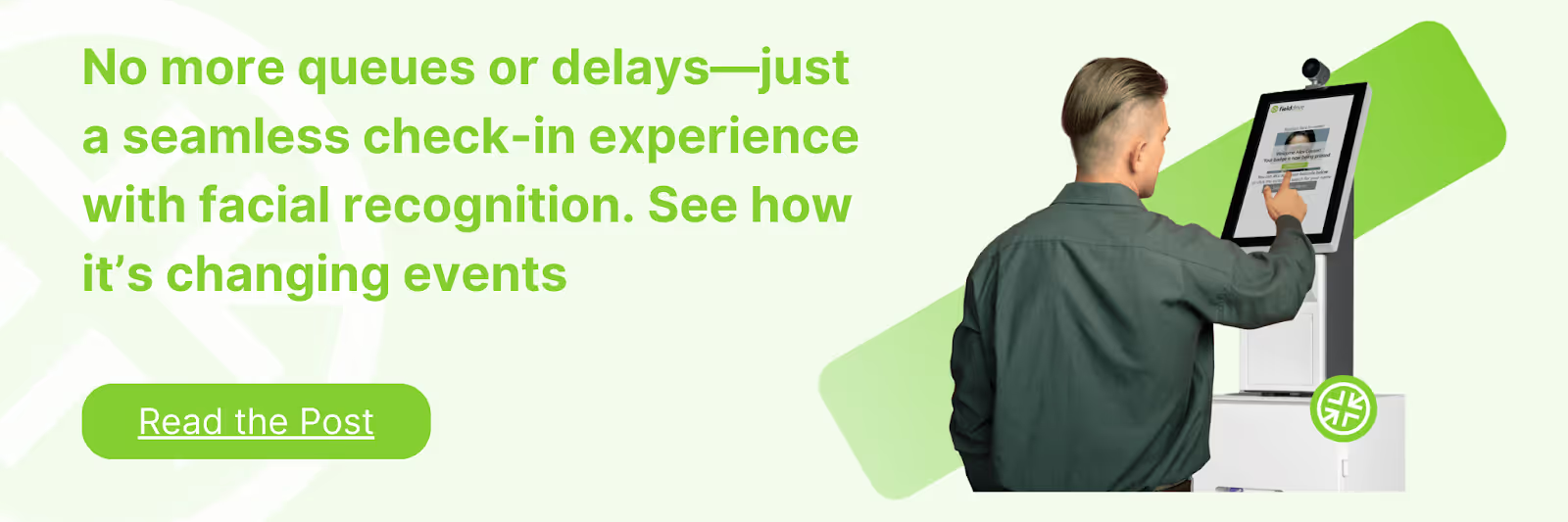
AI crowd management enhances this layer by automating access control powered by facial recognition. Instead of relying solely on printed credentials or manual scanning, facial recognition systems verify attendee identity in seconds.
How It Works in Event Environments
AI-powered facial recognition systems:
- Capture a live facial scan at the entry point.
- Match it against pre-registered attendee data.
- Approve or deny access instantly.
- Log verified entry in real time.
This reduces manual verification steps and minimizes human error. For large conferences and exhibitions, it adds a stronger compliance layer, ensuring restricted sessions, VIP zones, or paid-only workshops are accessed only by eligible participants.
Also Read: How AI Enhances Facial Recognition: The Essentials Explained
AI Crowd Management: Advantages, Operational Realities & Responsible Deployment
Adopting AI crowd management is more than just a technology decision. It’s an operational strategy choice. For Event Directors and Heads of Operations, the value lies in measurable performance gains. But responsible implementation requires understanding both the upside and the trade-offs.
Below is a decision-maker’s view of where AI delivers impact and where caution is required.
Strategic Advantages
1. Faster, Data-Backed Decision Cycles
AI systems process density, flow, and behavioral data in real time, enabling faster interventions during peak pressure moments.
Operational impact:
- Earlier congestion alerts
- Immediate anomaly detection
- Reduced lag between issue detection and action
- Shorter escalation chains
2. True Scalability at High Attendance
Manual oversight weakens as density increases. AI maintains monitoring consistency regardless of crowd size. It can simultaneously oversee multiple entrances, session transitions, exhibition floors, and VIP or restricted zones without adding operational complexity.
3. Smarter Resource Allocation
Through predictive modeling, AI enables demand-based deployment of:
- Check-in kiosks
- Security staff
- Session scanners
- Crowd control personnel
This reduces inefficiencies while strengthening preparedness during high-risk windows. For operations leaders, this means fewer last-minute staffing shifts and better cost control.
Operational & Ethical Realities
1. Cost & Infrastructure Investment
AI deployment requires hardware upgrades, software systems, ongoing maintenance, training, and integration. ROI must be tied to measurable metrics such as:
- Reduced queue times
- Improved entry throughput
- Lower congestion incidents
- Enhanced safety compliance
Without performance tracking, cost justification weakens.
2. Cybersecurity Exposure
Systems handling real-time surveillance and biometric data must be secured. Risks include:
- Data breaches
- Unauthorized system access
- Compromised monitoring feeds
Strong encryption, access controls, and compliance frameworks are critical.
3. Privacy & Regulatory Compliance
Facial recognition and surveillance technologies raise legitimate privacy concerns. As an event owner, you must:
- Clearly communicate data usage.
- Align with data protection regulations (e.g., GDPR).
- Define data retention policies.
- Maintain transparency with attendees.
4. Data Quality Limitations
AI accuracy depends on clean, reliable inputs. If data inputs are flawed, predictions degrade. The challenges may include:
- Poor camera positioning
- Incomplete historical data
- Environmental interference
5. The Human-in-the-Loop Imperative
AI enhances oversight, but it should not replace leadership judgment. That's because machines detect patterns, while humans interpret context. The strongest AI crowd management model combines:
- Automated detection
- Structured alerts
- Humans experienced in operational decision-making
Also Read: AI Event Matchmaking and Networking Platform
How fielddrive Strengthens AI Crowd Management from Design to Delivery
Implementing AI crowd management effectively isn’t just about deploying monitoring tools. Many vendors provide isolated AI analytics or surveillance systems but leave you to figure out how to integrate those insights into real, on-site operations. That gap shows up during peak entry surges, session transitions, or emergency responses, when alerts exist, but execution lags.
fielddrive was built to close that gap. With roots in live-event operations, fielddrive treats AI crowd management as part of a fully engineered on-site flow strategy rather than a standalone technology layer.
Here’s how fielddrive acts as a true partner in intelligent crowd management:
- Early-stage involvement, not reactive monitoring: Through its On-site Tech Advisory Program, fielddrive joins the planning phase early. This allows you to map attendee journeys, identify high-density zones, align entry capacity with projected peaks, and design layouts that reduce congestion risk beforehand.
- Intelligence-driven entry control: Touchless check-in kiosks with facial recognition and six-second live badge printing reduce entry friction and stabilize the first major density trigger. Faster throughput supports more predictable flow during peak arrival windows.
- Session access designed for controlled movement: Real-time session scanning and access control tools help manage room occupancy and prevent unauthorized access. This strengthens crowd management by balancing attendee distribution across spaces.
- Real-time data that translates into action: Live dashboards provide visibility into check-in velocity, session attendance, and movement trends. Instead of isolated alerts, you gain structured insight to adjust staffing, open additional lanes, or strategically redirect flow.
- Proven at scale and complexity: Delivered across 2,000+ events in 50+ countries, fielddrive supports high-volume conferences, exhibitions, and corporate summits. Global logistics hubs and on-site support ensure that crowd management strategies are executed reliably.
- Security, compliance, and privacy built in: From GDPR-aware facial recognition workflows to secure hardware infrastructure, fielddrive ensures intelligent crowd systems remain compliant, secure, and professionally deployed.

Wrapping Up
AI crowd management is transforming how high-volume events handle density, behavior, forecasting, access control, and emergency response. From real-time monitoring and predictive congestion modeling to behavioral detection and biometric entry, it lets you move from reactive crowd control to proactive flow management.
fielddrive supports this shift by embedding intelligent on-site design into the broader event ecosystem. Through early advisory, high-throughput check-in, controlled access systems, and real-time analytics, it helps translate crowd intelligence into structured execution. That way, data informs decisions and drives them.
If you’re evaluating how AI-driven crowd strategies could strengthen events, now is the time to assess your flow design, access controls, and data infrastructure. A focused working session with fielddrive can help you identify gaps, pressure-test assumptions, and determine what level of on-site intelligence your event truly requires.
FAQs
1. How will AI, 5G, and edge computing shape the future of AI crowd management?
The integration of AI with 5G and edge computing will enable faster data processing, lower latency, and real-time insights into crowds. This will further allow AI crowd management systems to detect congestion instantly, communicate alerts more quickly, and make more responsive, data-driven decisions during large-scale events.
2. Can AI crowd management integrate with existing event registration platforms?
Yes, but integration planning is critical. AI systems need access to check-in timestamps, session registrations, and access permissions to provide meaningful predictive outputs. Without structured data feeds from registration platforms, forecasting and occupancy insights remain limited.
3. Does AI crowd management work for indoor venues with poor connectivity?
It can, especially when edge computing is used. Processing data locally reduces reliance on continuous cloud connectivity. However, infrastructure assessments are essential before deployment to avoid latency issues that could delay alerts during peak density moments.
4. How do you calculate safe crowd density thresholds for events?
Safe density is typically measured in people per square meter. Thresholds vary by venue type, layout, and local safety codes. You should align AI alert triggers with fire regulations, evacuation capacity, and walking-speed decline curves under compression conditions.
5. Can AI systems differentiate between normal excitement and dangerous surges?
Advanced systems analyze velocity, directional shifts, and compression rates, not just movement spikes. Contextual modeling helps distinguish celebratory movement from risk-driven surges, though human oversight remains necessary for final interpretation during high-energy moments.
.svg)
.svg)
.svg)
Want to learn how fielddrive can help you elevate your events?
Book a call with our experts today


.svg)