

.svg)
.webp)
How to Increase Exhibitor Lead Capture Rates During Events in 2026
Use exhibitor lead capture solutions to optimize registration data and enable faster entry. Discover practical strategies to capture cleaner, qualified leads.
For event organizers, exhibitor success is the ultimate measure of an event’s value. You can deliver strong attendance and smooth logistics, but if exhibitors struggle to capture meaningful leads, their ROI and confidence in your event quickly erode.
Moreover, 64% of exhibitors say the quality of attendees is the most crucial factor when deciding whether to exhibit at a trade show. But even with the right audience on the floor, poor on-site execution, like slow entry, inconsistent badge data, or unreliable scanning, can prevent exhibitors from capturing the leads that justify their investment.
In this article, we'll discuss proven exhibitor lead capture solutions. You’ll learn how to measure performance, optimize pre-event and on-site workflows, and apply practical strategies to deliver higher-quality leads and greater exhibitor ROI.
What You Need To Know
- Despite having the right audience, poor execution at registration, check-in, and badge printing can prevent exhibitors from getting usable, qualified leads.
- Lead capture rate is the metric that matters. Measuring qualified leads against total scans reveals whether attendee data collected at check-in is actually translating into value for exhibitors.
- Operational setup drives on-site performance. Structured registration data, fast entry, standardized badges, and clear booth guidelines create the conditions exhibitors need to scan consistently and qualify leads efficiently.
- Dashboards, offline safeguards, and active oversight allow you to correct adoption, data, or flow issues during the event, before they impact exhibitor outcomes.
- Inconsistent data standards, poor badge designs, unclear exhibitor expectations, and late configuration changes reduce exhibitor confidence if left unchecked.
What “Exhibitor Lead Capture Rate” Indicates (And How to Measure It)
Too often, exhibitors judge success by booth traffic or total scans, while organizers look at attendance volume. Neither tells the whole story. The metric that actually reflects exhibitor ROI is the exhibitor lead capture rate.
At its simplest, the exhibitor lead capture rate measures how effectively attendee data collected at check-in becomes usable, qualified leads for exhibitors.
Formula: (Qualified leads captured ÷ total leads scanned) × 100
The most useful on-site information that helps you calculate it includes:
- Attendees checked in per hour: shows throughput and queue efficiency
- Scan success rate: how often badges scan cleanly on the first attempt
- Total leads scanned: volume of captured attendee data
- Qualified vs. unqualified leads: determined by exhibitor-defined criteria (role, interest, buying intent)
Example:
- Before (With incomplete data, inconsistent badges):
- 90 total leads scanned
- 20 qualified leads
- Lead capture rate = (20 ÷ 90) × 100 = 22.2%
- After (With clean registration data, fast check-in, and live-printed badges):
- 90 total leads scanned
- 45 qualified leads
- Lead capture rate = (45 ÷ 90) × 100 = 50%
Key Insight: From a check-in perspective, clean registration data and readable badges enable exhibitors to move smoothly from scans to qualified leads.
Note: B2B events often generate fewer leads overall, but those leads tend to be more qualified. That makes capture rate and data quality far more critical than raw volume.
Also Read: Selecting the Best Lead Retrieval Process for Your Events
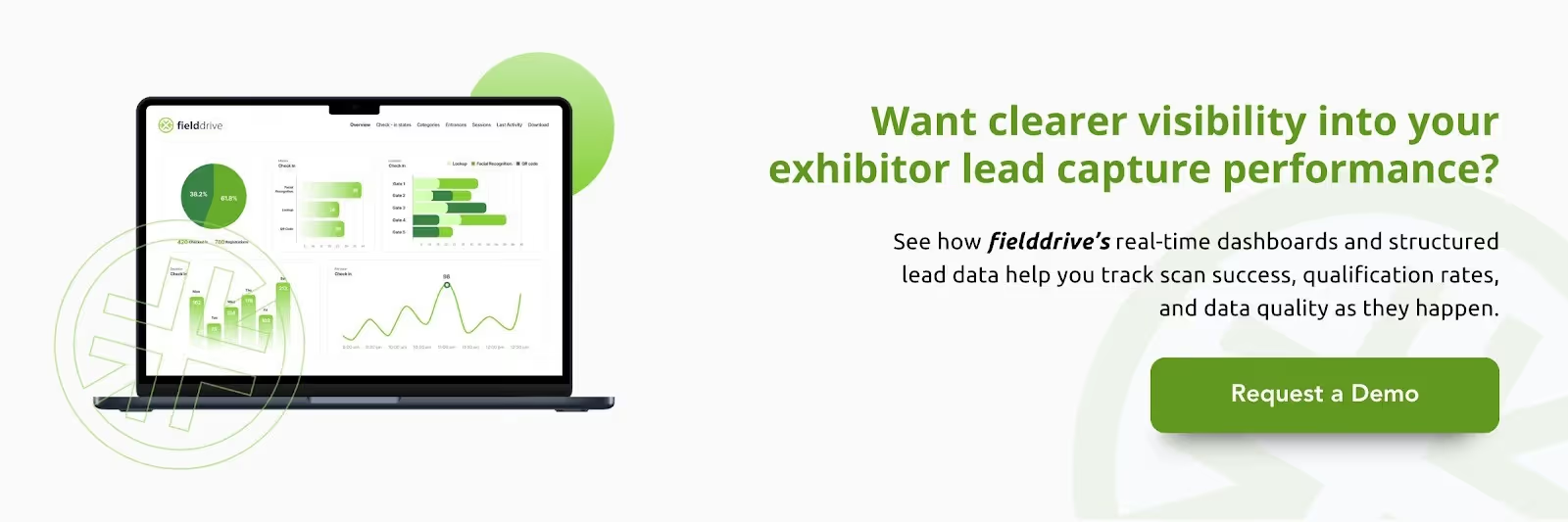
With the fundamentals in place, the next step is execution. Below, we break down the on-site strategies you can use to increase exhibitor lead capture rates in real event conditions.
Key Strategies to Increase Exhibitor Lead Capture Rates
Exhibitor lead capture rates are shaped less by booth behavior and more by how well the event is set up operationally. Registration data quality, check-in speed, and badge design all determine whether scans turn into qualified, usable leads or get lost in friction and manual cleanup.
By tightening the following foundations before and during the event, you can create the conditions exhibitors need to capture higher-quality leads.
1. Pre-Event Promotion to Drive Booth Traffic
Lead capture success starts before the actual event. Exhibitors can only capture quality leads if the right attendees show up with clear intent. That depends heavily on how you handle registration and pre-event communication.
What you should do:
- Design registration forms that collect structured, usable data (role, company, industry, buying intent, where appropriate).
- Encourage attendees to complete their profiles fully before arrival.
- Enable pre-event messaging through the event app or integrations so exhibitors can reach out to registered attendees in advance.
- Encourage short, personalized messages that explain the booth’s value or highlight brief walkthroughs.
- Recommend that exhibitors follow up with attendees who haven't responded 10–14 days before the event.
Why this matters for lead capture: When attendee data is complete and standardized, exhibitors can qualify leads the moment a badge is scanned without manual cleanup later. This directly improves the effectiveness of exhibitor lead capture solutions onsite.
2. Design an Eye-Catching, Inviting Booth Environment
While exhibitors own booth design, you can strongly influence outcomes through guidelines, layouts, and education. You can support better booth-level lead capture in the following ways:
- Provide clear exhibitor guidelines on booth flow and attendee accessibility.
- Encourage open layouts that allow easy entry and exit.
- Promote visible use of scanners and mobile devices to normalize scanning behavior.
Pro Tip: A roll-up banner and a looping video or slide deck showing how you solve real attendee problems can attract them.
3. Enable Faster Attendee Entry
Slow check-in frustrates attendees and reduces the time exhibitors have to capture leads. Entry speed is one of the most significant controllable levers for exhibitor ROI. Here are the major operational actions that make the greatest impact:
- Deploy touchless check-in kiosks using facial recognition.
- Use live, on-demand badge printing to avoid reprints, missing badges, and delays.
- Design entrance layouts that prevent congestion during peak arrival times.
Before vs. after impact:
- Before: Long queues → attendees rush the floor → printer malfunctions → fewer scans
- After: Fast entry → relaxed attendee flow → more consistent lead capture
Why this matters: When booths are designed for smooth attendee flow, scanning becomes a natural part of the interaction.
A good example of this in practice is fielddrive’s work with GlobalFoundries to simplify check-ins. Customized kiosks and on-demand badge printing slashed wait times. They made the entire entry experience smoother and more consistent for attendees, setting a strong foundation for exhibitors to capture leads cost-effectively. Read more.
4. Improve Badge Quality to Improve Scan Rates
Badge quality is one of the most direct factors affecting lead capture performance.
Organizer-led actions that matter:
- Use high-resolution QR codes or barcodes optimized for fast scanning.
- Standardize badge layouts across the event if possible.
Clean, readable badges remove friction at the exact moment leads are captured.
5. Equip Exhibitors with Smarter Lead Capture Workflows
For medium to large-scale events, software-based exhibitor lead capture solutions outperform manual or basic digital methods by automating scanning, qualification, and data storage. Hence, providing the right tools is just as important as providing access to leads.
What you should ensure:
- The platform supports multiple capture methods natively (badge scanners, QR codes, mobile scanning).
- Exhibitors don’t need separate systems or workarounds.
- Lead data is accessible in real time via a clear app or directly interfaced with the exhibitor's CRM.
Standard recommended workflow:
- The attendee’s badge is scanned instantly.
- The exhibitor applies custom qualification criteria (role, interest, buying intent).
- Relevant notes or tags are added on the spot.
- Lead data syncs in real time to the exhibitor’s CRM for immediate follow-up.
Also Read: Best Trade Show Lead Capture Apps for 2025
6. Use Real-Time Data to Optimize Lead Capture During the Event
As an organizer, waiting until post-event reports means missing the chance to fix problems while they matter. Here's how you should use real-time dashboards:
- Monitor scans per booth to identify which one may need manual support.
- Track scans per staffer to spot adoption or training issues.
- Identify peak engagement windows to adjust staffing or floor flow.
Operational safeguards:
- Ensure offline scanning is available during Wi-Fi drops.
- Maintain reliable syncing, so leads flow cleanly into exhibitor systems.
Here’s a quick checklist to ensure nothing critical is missed when setting up exhibitor lead capture onsite.
Organizer Checklist: Setting Up for Strong Exhibitor Lead Capture
This checklist covers what should be in place, but real-world events rarely run perfectly. The following pitfalls show where lead capture can quietly suffer, even when the basics are covered.
Common Pitfalls That Quietly Undermine Exhibitor Lead Capture
Even with the right tools in place, exhibitor lead capture can break down due to subtle decisions that often go unnoticed. The pitfalls below focus on structural and data-related gaps that quietly reduce lead quality and exhibitor confidence, long before follow-up begins.
- Inconsistent data standards across systems: When registration, badges, and lead capture use different field formats, exhibitors receive messy data that’s hard to sync and act on.
- Badge designs optimized for branding, not scanning: Overbranding or poorly placed QR codes slow scans and reduce capture rates during peak floor traffic.
- Unclear exhibitor expectations before the event: If exhibitors don’t know what data they’ll receive or how lead capture works, adoption suffers regardless of the technology provided.
- No real-time visibility into data quality: Scan volume may look healthy, but missing or incomplete fields often go unnoticed until post-event follow-up fails.
- Last-minute changes to registration fields or badge layouts: Late adjustments often break data mappings and lead to incomplete or mismatched lead records once scanning begins.
Eliminating these issues allows you to move from troubleshooting to delivering consistent, high-quality results for exhibitors.
Also Read: How to Choose Enterprise Event App Software for Enhanced Engagement
Final Thoughts
Strong exhibitor lead capture doesn’t happen by chance. It’s the result of deliberate, organizer-led decisions, from how attendee data is collected and badges are printed to how entry flows are managed. When you set these foundations correctly, exhibitors spend less time fighting friction and more time capturing qualified, usable leads that justify their investment.
This is where fielddrive fits naturally into the picture. Built by event professionals, it combines facial recognition check-in technology, contactless event check-in kiosks, a powerful lead retrieval app, and actionable insights into a single system. Instead of treating check-in, badge printing, and lead capture as separate challenges, fielddrive connects them to ensure reliable lead capture that exhibitors can trust.
If you’re looking to improve exhibitor lead capture rates and prove ROI more clearly at scale, it’s time to rethink your on-site setup. Reach out for a demo to explore enterprise-grade exhibitor lead capture solutions designed for real-world conditions.
FAQs
1. How do we fairly compare lead capture performance across exhibitors?
To compare performance accurately, normalize results by factors like booth size, traffic volume, and event duration. Looking at qualified leads per hour or per 100 attendees provides a more realistic benchmark than total leads alone.
2. How do multi-track or multi-hall events impact lead capture accuracy?
These introduce challenges like uneven traffic distribution and delayed syncing. Without centralized data handling and consistent badge formats, exhibitors may see fragmented lead records that are harder to reconcile after the event.
3. Do privacy regulations like GDPR affect exhibitor lead capture at events?
Yes. You must ensure consent is captured during registration and clearly communicated at check-in. Exhibitors should only receive fields that attendees have explicitly agreed to share. Otherwise, lead usability and compliance are both at risk.
4. Is it better to restrict lead fields or give exhibitors complete attendee profiles?
More data isn’t always better. Providing a focused, pre-defined, standardized set of high-value fields improves scan speed and follow-up efficiency. Overloaded profiles slow qualification and often cause exhibitors to ignore large portions of the data.
5. Does exhibitor lead capture performance vary by event type?
Yes. Conferences with heavy session schedules often yield fewer but higher-intent leads, while trade shows generate higher volume with broader intent. You should align lead capture expectations and reporting with the event format.
.svg)
.svg)
.svg)
Want to learn how fielddrive can help you elevate your events?
Book a call with our experts today


.svg)